Skip to content
Platform

The platform that reads every drawing your plant depends on.

Armeta's extraction engine reads any PDF P&ID — scanned, native, historical, as-built — and produces structured, connected engineering data. Built from the ground up for the specific geometry, symbology, and conventions of industrial piping and instrumentation diagrams. Not a generic OCR. Not an LLM wrapper. A purpose-built extraction layer.

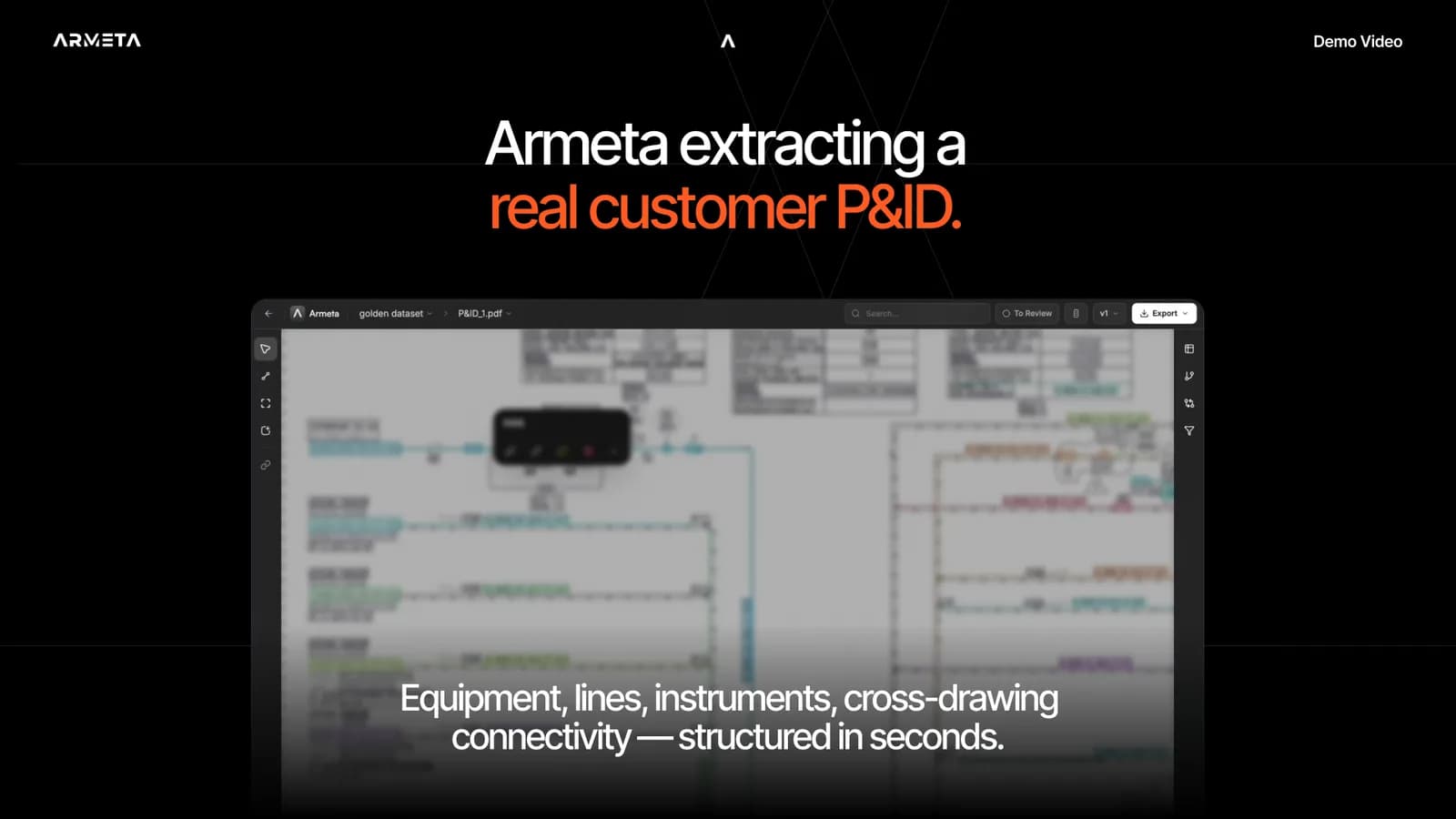
Armeta P&ID extraction demo
How it works

Five stages, one engineering graph.

Every P&ID that passes through Armeta is processed in five stages. Each stage is inspectable, editable, and auditable. Every output is tied to a specific source region in the original drawing — drawing-traceable by design.

Stage 01

Ingest

Bring any P&ID, in any format.

Armeta ingests PDFs regardless of origin: scanned paper drawings, native CAD exports, historical archives, as-builts, and vendor deliverables. The ingest pipeline handles multi-page documents, mixed formats within a single archive, and drawings produced in any era of industrial CAD software.

Batch ingest is available for full-unit or full-facility archives.

File types
PDF (native + scanned), PNG, TIFF, JPG
Batch ingest
Unit- or facility-scale archives
Typical throughput
Hundreds of drawings / day
Stage 02

Extract

Equipment, lines, instruments, tags, spatial relationships.

The extraction engine identifies every symbol, tag, annotation, and line on the drawing. For each object, Armeta produces a structured record including object type (pump, valve, instrument, equipment, line), tag or label, service designation, size, material, and spatial position within the drawing.

Armeta configures to your facility's symbol library, tag conventions, and drawing standards during initial setup. Every customer has a different library; Armeta works with all of them. Every extraction is reviewed by Armeta's engineering team before delivery.

Objects
Equipment, lines, instruments, tags, notes
Configures to
Your symbol library + conventions
Validation
Engineer-reviewed before delivery
Stage 03

Connect

Cross-drawing pipe connectivity via off-page connectors.

A P&ID in isolation is incomplete. A full process system lives across tens, hundreds, or thousands of individual sheets — connected by off-page connectors, unit boundaries, and reference notes.

Armeta reads the off-page connector annotations on each drawing and builds the global connectivity graph across every related P&ID in the set. The result is a facility-level or unit-level engineering graph that knows where every pipe goes, across every drawing.

This is where single-sheet extraction tools stop and Armeta keeps going.

Scope
Unit-level or facility-level graph
Connectivity
Off-page connectors reconciled
Stage 04

Compare

Every change between revisions, flagged and auditable.

Armeta compares any two revisions of the same P&ID and produces a structured delta: what was added, what was removed, what was modified. Every change is tied to a specific region on the drawing and can be reviewed visually, exported as a change report, or fed directly into MOC documentation.

This capability eliminates the “two prints and a red pen” reality of how most operators track drawing changes today.

Output
Structured delta, change report, MOC feed
Traceability
Every change drawing-region tagged
Stage 05

Deliver

Feeds your engineering systems, IT stack, and digital twins.

Armeta's outputs are consumed via three channels: direct API integration, JSON exports for custom pipelines, or Excel deliverables for non-technical teams. The structured data is designed to feed into the systems your organization already runs — engineering document management, asset databases, digital twin platforms, and compliance software.

Every output is versioned and traceable back to the source drawing and source region.

Channels
REST API · JSON · Excel
Versioning
Source drawing + region retained
Accuracy and validation

Accuracy you can put in a contract.

Every extraction Armeta delivers is validated by our engineering team before it reaches you. This is not a pass-through of raw model output. It is a deliverable with an accuracy commitment.

Accuracy metrics on your own drawings are produced as part of the initial P&ID audit — our ten-drawing free assessment that establishes baseline performance before any paid engagement.

Visual review of every drawing

Every extracted graph is reviewed by an engineer against the source drawing before delivery.

Statistical accuracy sampling

Equipment, line, and instrument-level sampling against ground truth on every engagement.

Cross-drawing connectivity validation

Off-page connectors reconciled across the full set; dangling references flagged.

Revision delta review

Change reports reviewed against the source drawings before MOC packages are produced.

Deployment

Your drawings. Your environment. Your terms.

Three deployment modes, chosen to match the security and governance constraints your engineering records actually live under.

Mode 01

Cloud

Fastest time to value

Armeta-hosted, isolated per customer. Your P&IDs and extracted data remain segregated from every other customer environment.

  • Isolated tenant per customer
  • Data residency US, EU, or customer-designated region
  • Production-ready in days, not months
Mode 02

On-premise

Your network, your perimeter

Armeta's extraction engine runs inside your network. Your drawings never leave your environment. Deployed with customers today under data residency and air-gap requirements.

  • Drawings never leave the customer network
  • Air-gap-compatible deployment
  • Suitable for classified processes and strict residency policies
Mode 03

Private cloud

Managed inside your tenant

Armeta-managed deployment inside your own cloud tenant. Cloud operational model, customer-controlled perimeter.

  • Customer-controlled cloud perimeter
  • Managed service lifecycle
  • Fits existing cloud governance frameworks
Security

Built for the facilities that cannot afford to get this wrong.

Armeta meets the standards your security team expects. For security questionnaires, due diligence requests, or deeper technical detail, contact the Armeta team.

SOC 2 Type II audit

Independent audit in progress, completing H1 2026.

Data residency

US, EU, or customer-designated region.

Enterprise SSO

Integrates with your existing identity provider (SAML / OIDC).

Role-based access control

Granular permission management across users, projects, and data scopes.

End-to-end encryption

In transit and at rest, using industry-standard ciphers.

Full audit trail

Every action logged and retained for compliance purposes.

Integration

Fits the engineering stack you already run.

Armeta's outputs are designed to feed the systems your organization already uses. Integration is delivered via API, JSON export, or structured Excel files. For specific integration patterns and deployment guides, see the Resources section.

Engineering document management systems

Asset management and maintenance platforms

Process historian and operations data systems

Digital twin platforms

Process safety management software

LDAR compliance databases

ERP and procurement systems

Custom pipelines via API or JSON

Your drawings, your data

Start with ten of your own drawings.

Before any procurement conversation, see Armeta run on your actual P&IDs. Not sample data. Not a generic demo. Your drawings, extracted, delivered as a structured report in one engagement.